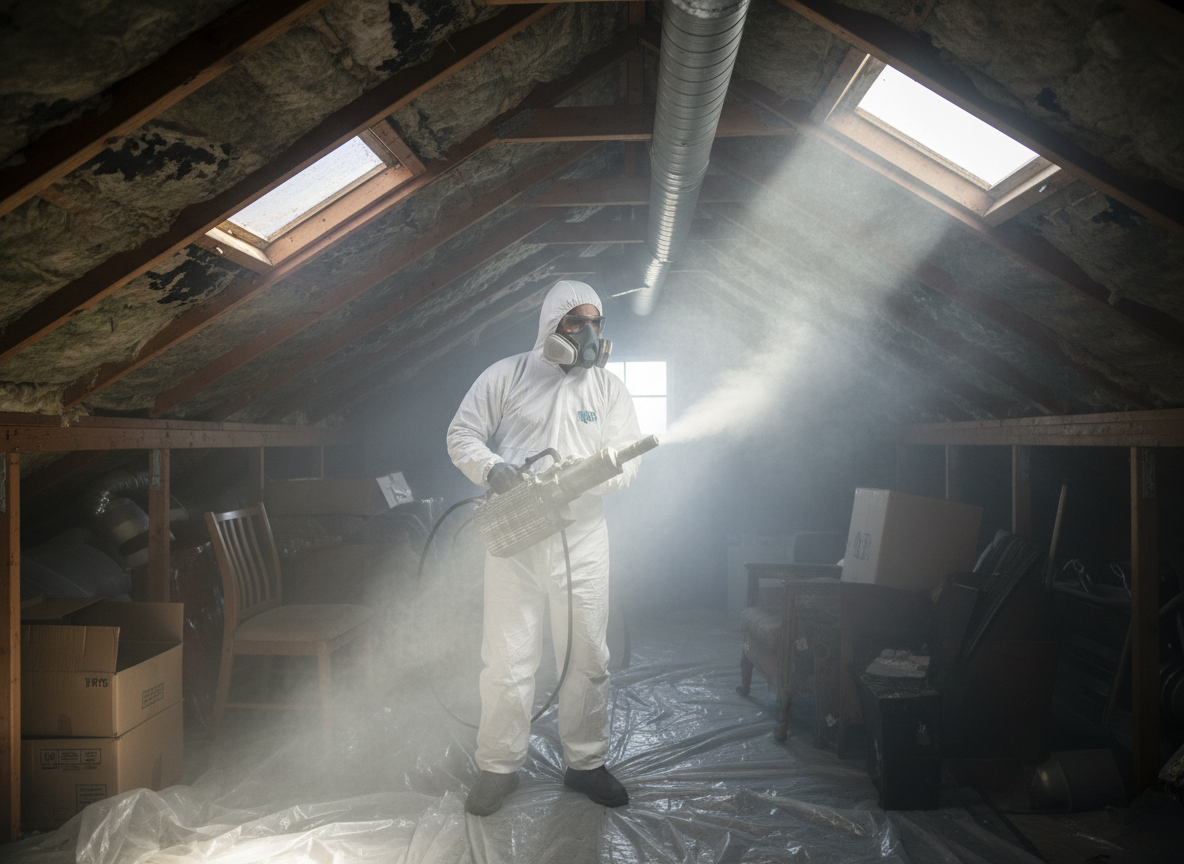
Chatsworth homes built from the 1960s through the 1980s in neighborhoods like West Chatsworth and near Chatsworth Park South often have stucco exteriors and slab foundations that trap moisture after rare winter rains or plumbing leaks. Mold fogging treatment uses a fine mist of antimicrobial solution that travels into those hidden voids where surface cleaning alone cannot reach. The process requires sealing the structure first so the fog stays suspended long enough to contact every surface, then running HEPA air scrubbers to remove neutralized particles. Technicians must monitor humidity levels because our hot dry summers can drive remaining moisture deeper into drywall if not addressed.
In Los Angeles County properties near Santa Susana Pass State Historic Park or Orcutt Ranch, hillside terrain and older HVAC systems create temperature differentials that condense moisture inside ductwork. Fogging reaches those ducts and insulation layers without demolition when the infestation is caught early. We always test for hidden water sources first because fog alone will not stop regrowth if a roof leak or irrigation issue continues feeding the mold. Post-treatment clearance sampling confirms spore counts have dropped below outdoor baseline levels before we reopen the space.
Residents in Downtown Chatsworth and nearby Northridge or Canoga Park frequently call after noticing musty odors following the mild winter months when windows stay closed. Fogging treatment works best on non-porous surfaces and in cavities; porous materials like carpet padding or heavily saturated drywall still require removal. We coordinate with homeowners on pet and plant relocation because the fog can irritate sensitive lungs even when the product is low-toxicity. Follow-up visits check for rebound growth once normal airflow resumes.
Technician insight
In Chatsworth the thing that catches most people out with mold fogging treatment is how our dry summers push residual moisture deeper into stucco walls and under slabs after a winter leak, so the fog reaches the mold but the water source stays hidden until the next rain cycle.
Hidden Moisture in West Chatsworth Attic
A homeowner in West Chatsworth noticed a musty smell after a slow roof drip during mild winter rains. We found condensation trapped in insulation near the HVAC plenum. Fogging reached the cavity without opening the ceiling, followed by targeted drying and sealing. Clearance tests passed and the odor did not return.
How it works
- 1
Inspection and Containment
We map moisture sources and seal the affected rooms to prevent spore spread into unaffected areas of the Chatsworth home.
- 2
Fog Application
EPA-registered fog is dispersed throughout cavities and living spaces, allowing contact time for spore neutralization.
- 3
Air Scrubbing and Ventilation
HEPA filtration removes suspended particles while we monitor humidity to avoid re-condensation in our dry climate.
- 4
Clearance Testing
Air samples are collected and compared against outdoor baselines before the space is returned to normal use.
Pricing
Cost depends on square footage treated, number of cavities accessed, and whether contents require separate fogging; we provide upfront quotes after inspection.